Showing posts with label rhinoplasty. Show all posts

Wednesday, September 11, 2019

Double eyelid surgery and rhinoplasty precautions and recovery tips

What are precautions for double eyelid and rhinoplasty surgery?
Double eyelid surgery and rhinoplasty plastic surgeries are one of the most popular in South Korea. Many visitors of id Hospital prefer to have multiple procedure in order to save time and avoid undergoing anesthesia several times. Here are some precautions and tips from ID Hospital before and after double eyelid surgery and rhinoplasty that can help you to recover faster.
Post image
Double eyelid surgery and rhinoplasty in ID Hospital

Before surgery:
⚠️ Notify doctor if you have hypertension, diabetes, thyroids, allergies, anemia, cold or undergoing any treatment of medical illness. Consult with a doctor if you are obligated to take any medicine, hormones, herbs.
🚫 No alcohol or smoking 1-2 months before and after the surgery, as it may affect blood pressure, blood sugar level and blood vascularization.
🚫 No food or water at least 6 hours prior to the surgery for anesthesia to work.
🚫 No manicure and pedicure nail coloring, no jewelries, piercings.
After surgery:
❄️ For the first 48 hours swelling will be severe. Use cold pack on the swollen area for the first 3 days.
πŸ”₯ Switch it to warm compression after the 3rd day.  
🍴 Avoid oily, greasy, fatty foods during recovery so the swelling will go down faster.
🏨 Sleep in a position when you head is above your heart level

Eyelid Surgery

Post image
Double eyelid surgery recovery, ID Hospital

  1. Avoid excessive crying, rubbing the eyes, or squinting too hard
  2. Avoid wearing contacts for about three weeks following the surgery.
  3. Too much tension on the eyes can lead to bleeding or other unwanted unnecessary consequences.
Nose Surgery

Post image
Rhinoplasty recovery, ID Hospital

  1. Avoid wearing glasses for about one month following the surgery
  2. A week following the surgery, light blowing may be permitted, however four weeks after, you may blow more naturally.
You can read more details about nose recovery process and eye recovery process in ID Blog.

At ID Hospital, we offer free online consultations for all our patients. Find out your quote today by clicking the pink link below. 

Thursday, January 3, 2019

Healing process for forehead reduction process


One of our most requested posts is the healing process for forehead reduction surgery.


Forehead reduction surgery is used to lower the hairline, therefore decreasing the forehead height.

Compared to other facial contouring surgeries, the recovery is faster.


To read the whole post, click here!

Thursday, December 6, 2018

Recovery process for rhinoplasty in korea


Before having surgery, many people are worried about the recovery process for rhinoplasty. Just like any type of surgery, the healing process differs per individual. 

However, we put together healing process timeline to help you prepare better for your surgery in Korea.

The most important thing to keep in mind is that, the recovery time differs per individual, the swelling level, bruising if any, all differ per individual so that is something to keep in mind when considering any kind of surgery.


Even though the minor swelling is usually gone in 6 months, it doesn’t mean your nose is fully healed. 6 to 12 months is good time frame to consider for total recovery from rhinoplasty.


 Recovery Process for Rhinoplasty


Recovery Process for Rhinoplasty : Before Surgery

The surgeon will see you for a consultation and prior to surgery, draw a design and prepare your surgical plan. The surgery is done under local anesthesia with sedation at ID Hospital.

Surgery Day

1.      You have to be fasted for 6 hours before surgery (no food, water or even medicines)
2.      If you are taking any prescription medication, then make sure to take the medication as advised.

Recovery Process for Rhinoplasty : After Surgery

Major swelling takes 2 to 3 weeks to reduce but you can get back to your normal routine after the cast is removed.

The swelling heals asymmetrically and moves downwards due to gravity, so the nose tip usually stays swollen the longest.

If you have bruising, then use sunscreen and wear a heat to protect your bruised skin from direct sunlight. Do not forget to follow the post-surgery disinfection and ointment instructions twice a day, and medication 3 times a day.


Recovery Process for Rhinoplasty : 1-3 Days Post-surgery

Avoid putting any pressure on your nose.

Do not sleep sideways or facing downwards, sleep on your back and keep your head level above your heart level.

For the first 3 days, apply an ice pack (provided) to help reduce the swelling.

Avoid salty, spicy, greasy foods to heal faster.


Recovery Process for Rhinoplasty : 1 Week later (cast and stitches removal)

From the fourth day onwards, use the warm to help reduce the swelling (check the temperature on your hand first)

After your stitches are removed, then you can wash your face and wear makeup, but be careful not to use too much pressure on your nose.

You will have a swelling care session if you had surgery at ID Hospital.

You cannot go to the sauna/steam room for 4 weeks

Avoid smoking and alcohol for 1-3 months after surgery

Do not wear glasses or exercise for a month after surgery


3-6 Months later

At this point, your nose should be sharper than before but it is still healing.

6 Months to a year

At this point, your nose has healed almost completely and you will be able to see the final results.


Recovery Process for Rhinoplasty : Tips to help you heal quickly

1.      Do not be impatient and assume the worst right after surgery. You need to wait to see the surgery results, sometimes for at least 6 months so be patient and allow your body to heal.

2.      For the first month at least, do not touch or move your nose around too much.

3.      Wear sunscreen whenever you head outside.


If you have any further questions, leave us a comment below.

Wednesday, December 5, 2018

How to get a rhinoplasty in Korea: From A to Z


Rhinoplasty in Korea is a hot topic because it is the most popular plastic surgery in Korea.

Rhinoplasty, also known as nose job, has been around for more than a century and is the most performed surgery, especially in Korea.

What you need to know about Rhinoplasty in Korea


Due to the position of the nose on the middle of the face, the shape and size are important for a balanced face. Altering the nose with surgery will also alter the other facial features, particularly the chin.

The most popular nose is a Barbie-like nose, small with either a curved or straight, high nose bridge and slim nostrils.

Rhinoplasty in Korea: Types of surgeries

Rhinoplasty methods vary depending on the individual’s nose and facial proportion.
Based on your nose shape, the doctor will specify which procedures you need to get your desired nose shape.

Rhinoplasty can include the below procedures (they can be done together) to shape the nose.


Silicone implant: When the nasal bridge is low, the nose tends to look wide. To correct this, a silicone implant is used to increase the height of the nasal bridge. This projection with the implant creates a more prominent nasal bridge.

Alarplasty: The nostril width is lessened by removing part of the nostrils, and sewing the incisions part together. Reducing the alars also reduces the overall size of the nose.

Septoplasty: If your septum is deviated, a septoplasty is needed to correct the deviated septum.

Osteotomy: If the nasal bridge is wide, then osteotomy is required narrow it down. The surgeon breaks/fractures the bones then brings them closer to create a narrow nasal bridge.

Hump reduction: The nasal dorsum is protruded (hooked nose) and a hump reduction reduces the bone or cartilage to make the dorsal hump flat.

Columelloplasty: If the columella (bottom part of the nose) is drooping low, then surgery can be used to fix it. The columella can be re-shaped to lift it upwards.

Tipplasty: Tip plasty is procedure to lift or make the nose tip thinner. Your own nasal septal cartilage is used or mesh/donated cartilage is used to shape the tip. 

Rhinoplasty in Korea: What to expect


Consultation: An X-ray is performed for the surgeon to be able to see the structure of the patient’s nose. Along with the X-ray, the patient has to be examined by the surgeon in order to determine which rhinoplasty procedure is suitable.

Surgery: surgery lasts 2 to 3 hours (without anesthesia time)

Surgery symptoms: swelling and bruising occur after surgery, and scars take 3-6 months to fade.

Recovery: Cast is worn for 7 days after surgery. After the stitches are removed, then the surgery area can be washed lightly.

Major swelling: lasts from 2 to 3 weeks

Minor swelling: lasts from 3 to 6 months

Rhinoplasty in Korea: Pre-surgery Care

1.      Do not smoke or drink alcohol for a week minimum before surgery.
2.      You have to be fasted before surgery (follow given instructions).
3.      Avoid aspirin or any type of blood thinner for 7-10 before surgery.
4.      Remove all manicure, pedicure, accessories, piercings or anything metallic before surgery.


Rhinoplasty in Korea: Post-surgery Care

1.      Do not smoke or drink alcohol for a month after surgery (3 months is better) to avoid any complications.
2.      Follow the correct sleeping positions and post-surgery care instructions.
3.      Use the ice pack/ warm packs as per instructions.
4.      Do not wear glasses, blow your nose or rub your nose hard for a month after surgery.


Monday, November 26, 2018

How to get the perfect V-shaped chin?


A lot of people wish their chin was a bit sharper and the chin can actually be made sharper with genioplasty.

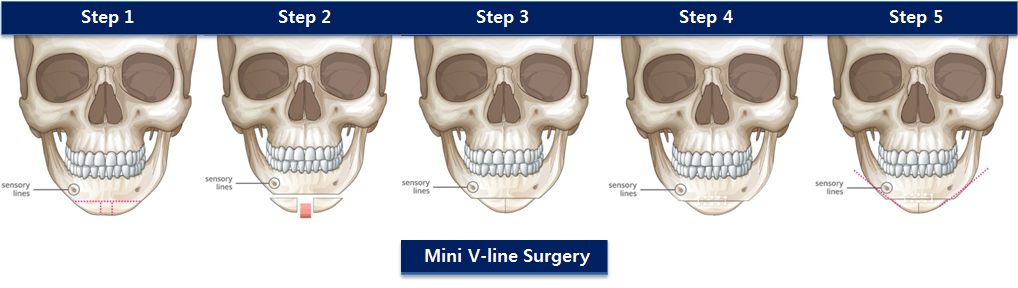
Genioplasty (also known as Mini V-linesurgery) is a type of surgery done on the chin. It is considered an aesthetic surgery performed by a maxillofacial surgeon under general anesthesia.


Genioplasty surgery method is used to narrow, shorten, elongate, push forward or bring the chin area backwards. T-osteotomy is the basic method used for resecting the bones, but the surgery can get customized depending on the individual’s bone structure.


Nerve Lines and muscles

The inferior alveolar nerve supplies sensation to the chin and lower lip and teeth. Great caution must be taken not to cause any damage to the nerves as it can lead to permanent nerve damage.

The mentalis muscle is attached to the chin. It is detached during surgery for the osteotomy and must be re-attached with caution.

What is T-osteotomy method?

T-osteotomy method was developed by ID Hospital, and published in various plastic surgery journals.
The method involves resecting the bone horizontally and leaving a small part of the bone intact. The bones are then shaped and fixated with titanium screws and this surgery changes the shape of the chin.


The surgeon checks your chin length, width and nerve lines location. Then the length of the philtrum and chin are compared to check if your chin is long or short. Since the incision area is inside the mouth, the stitches will not be visible to others, and the scars heal fast.

The type of chin you have determines the osteotomy method most suited for your chin.

Wide and round chin: T-osteotomy is performed and a small section of the bone is removed. The remainder of the bones are attached together and fixated with pins and screws.

Long chin: Along with the basic T-osteotomy method and additional horizontal piece of bone is resected to remove the excess bone.

Protruded chin: Along with the basic T-osteotomy method, the protruded bone is resected and the tip of the chin is brought backwards to balance the chin shape.


Short chin/Receded Chin: For the short chin, the bone is resected, the fixated with pins to elongate the chin. With the receding chin, an extra step is performed to advance the chin forward to its normal position.

Asymmetric chin: With the asymmetric chin, the amount of bone resected from each side will differ. The surgeon has to make measurements to assure as much symmetry as possible.

As with all surgeries, having a Board-certified plastic surgeon perform your surgery will get you the best results the first time around.


Friday, November 23, 2018

4 Tips to help you when selecting a facial contouring surgeon


Too many doctors…and you can only select one for your surgery.

How do you go about making that selection?

We put together a criteria list of important information to check about your surgeon before going under the knife.

1. Research

We cannot stress enough how important research is. Research involves checking credentials, checking previous patients’ results and asking questions. 

A board-certified plastic surgeon is completely different from a cosmetic surgeon so you have to make sure that the selected surgeon is qualified and experienced to perform your surgery. The surgeon should be able to give you the best results with the first surgery only.


Another point it, learning what the procedure entails and getting answers about any questions you have during the face to face consultation with the surgeon. 

The questions can include surgery procedures, anesthesia, surgery duration, post-surgery care etc. and should be addressed to the surgeon directly. Take notes if you have to during the consultation, so you have all the information you need to make an informed decision.

2. Anesthesia

A board-certified anesthesiologist should administer the anesthesia and monitor your condition throughout the surgery duration. You have to make sure that an anesthesiologist will be present and is trained to take action if required.


If you are taking any medication or have any disorders or symptoms, for your own safety you have to make sure to disclose your medical history.

3. Surgery facilities

People may not think of the surgery facilities being important, but a clinic needs to have the proper space and facilities for surgery with trained staff members. You can check if you will stay overnight, and what services are offered by the clinic to care for you post-surgery. 


4. Dealing with surgery results or medical emergencies

Post-surgery care is just as important as the surgery itself. Be sure to check how they will resolve post-surgery issues. Another important part is checking what would happen in case of a medical emergency. Surgery complications, although not so common, can still happen, so make sure that you are in good hands.

As with anything in life, proper planning is crucial so take the time and consider all your options.

Thursday, November 22, 2018

FFS Results - Gabbie's 6 months post-surgery results at ID Hospital


Gabbie visited ID hospital 6 months ago to have her FFS procedures. During her 1 month post-surgery interview, she still had some swelling.


We caught up with her at the 6 months post-surgery mark, to check her progress.


ID: Hi Gabbie! It’s been 6 months since you had surgery, so tell us how did you progress after you left Korea? How was the healing process? 

Healing was very gradual. Since I had V-line surgery and Cheekbone reduction surgery (facial contouring surgery), I had a lot of swelling.

The doctors had explained that to me prior to surgery so I was just focusing on healing. Every day I could see my face getting smaller and more defined so I knew that I just needed to be patient.

ID: How do you feel after having your surgeries? Are you satisfied with the results?

I am very satisfied with my surgery results. In fact, I am planning to go back for additional surgeries. That’s how much I trust ID hospital to make me look more beautiful.
  
ID: Have the surgeries improved your confidence the way you imagined?

Very much! Before surgery, I hated putting my hair up, I just didn’t like the way I looked. Now I love trying new hairstyles, tying my hair up. Etc.


ID: How did your friends and family react after seeing your surgery results?

They noticed right away how my face became more feminine and my facial features became more defined. Especially the nose! I love the way I look now.

ID: Do other people notice you have had surgery? Do you talk about your surgeries to others?

Yes, they do notice the change. The surgeries have made me more beautiful and yes, I do discuss it with others because I simply love the surgery results.

ID: Will you have more surgical procedures?

Yes, absolutely. I want to get a lifting procedure like my doctor had recommended and some fat graft.


ID: Would you recommend ID Hospital to others, and why?

Absolutely!!!! ID hospital is the best hospital! No questions about it.

ID: Any tips for patients coming to Korea to have surgery for the first time?

It is important to find a hospital that can really change you for the better. ID hospital surely has a lot of specialist doctors to help you achieve a natural, fabulous face, the surgery results speak for themselves.
  
ID: What would you like to say to other patients? Any messages you would like to share?

Don’t just trust any hospital. Trust ID hospital. I am a living proof of how my life has changed tremendously. My face looks better than I ever imaged, beyond my wildest dreams and I am happy to have had my surgeries there.


Just like Gabbie, you can also change your life and finally feel comfortable in your own skin, with FFS. ID Hospital is the top plastic surgery Hospital specialized in FFS. Contact us here for an online consultation.